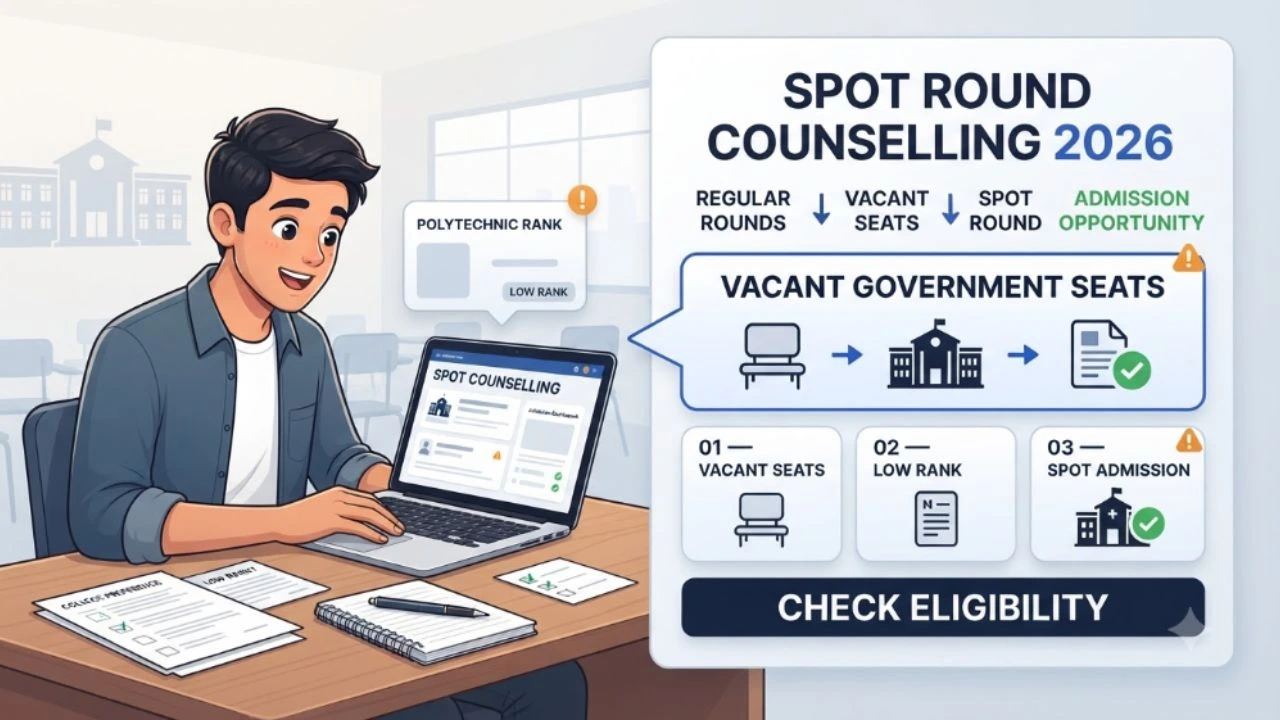
For many students, the regular polytechnic counselling rounds do not end with the college or branch they wanted. Some miss out because of a low rank, while others do not receive a seat because their preferred choices were highly competitive.
The spot round can provide another opportunity when seats remain vacant after the main counselling process. Government polytechnic colleges may have vacant seats because selected candidates do not report, withdraw their admission, or move to another institute.
However, spot admission is not a guaranteed second chance for everyone. The rules, eligibility conditions, registration process and vacant-seat list depend on the state admission authority and the particular counselling system.
Table of Contents
What Is Polytechnic Spot Round Counselling?
Polytechnic spot round counselling is generally conducted after the regular counselling rounds when seats are still available. The vacant seats can arise in government, aided or private polytechnic colleges. Depending on the state, these seats may be filled through an online spot round, special counselling, institute-level admission or another process announced by the admission authority.
The important point is that spot counselling does not usually mean that every college will have seats available. Popular government colleges and branches can fill their seats during the first few rounds. Vacancies are more likely to appear in less preferred branches, colleges located away from major cities, or institutes where some allotted candidates do not complete admission.
Can Students With Low Ranks Get Government Polytechnic Seats?
Yes, a low rank does not automatically end your chances of getting a government polytechnic seat. The possibility depends on the number of vacant seats and the demand for a particular branch and college. A candidate who could not secure Computer Science or another high-demand branch during regular counselling may find vacancies in Civil, Mechanical, Electrical or other branches.
The same principle applies to college selection. A government polytechnic that was difficult to get during the first round may become available later if seats remain vacant. Still, candidates should keep expectations realistic. A low rank does not guarantee admission simply because a spot round has been announced.
Who Can Participate in Polytechnic Spot Counselling 2026?
Eligibility differs between states, so the official 2026 counselling notification should be checked before applying.
In general, candidates may need to meet these conditions:
- Meet the eligibility requirements for the selected diploma course.
- Have completed the required qualifying examination.
- Hold a valid entrance examination rank where the state requires one.
- Complete spot-round registration within the announced deadline.
- Follow the required document verification process.
- Pay the prescribed counselling or admission fee.
- Satisfy state domicile or category requirements where applicable.
Some counselling authorities may also allow candidates who did not receive a seat in earlier rounds to participate. Others may permit candidates who received a seat but did not accept it, depending on the rules. This is why students should not rely on previous-year procedures alone. Spot-round rules can change from one admission cycle to another.
How Polytechnic Spot Round Counselling Works
The process is usually shorter than the main counselling cycle, so candidates need to keep track of notifications.
1. Check the Vacant Seat List
The admission authority generally releases information about seats remaining after regular counselling. Check the college, branch, category and seat type carefully. A vacancy in a particular college does not necessarily mean that every branch has an open seat.
2. Check Your Eligibility
Before selecting a vacant seat, confirm that your qualification matches the branch requirements. Some diploma programmes have subject-specific eligibility rules. A candidate who qualifies for one programme may not necessarily qualify for another.
3. Register for the Spot Round
If separate registration is required, complete it before the deadline. Keep your entrance exam details, application number, academic records and other required information ready.
4. Select Available Colleges and Branches
This is where flexibility can improve your chances. If the primary goal is to secure a government polytechnic seat, limiting choices to one highly competitive branch can reduce the available options. A wider selection of acceptable colleges and branches gives you more possibilities.
5. Attend Verification or Reporting
Some states conduct spot admission through an online process, while others may require candidates to report physically to a designated centre or institution. Follow the exact instructions issued for 2026.
6. Accept the Seat and Pay Fees
If you receive a seat, complete the admission formalities within the specified period. Do not assume that an allotted seat will remain reserved indefinitely. Spot rounds usually operate within tight deadlines.
How to Improve Your Chances With a Low Rank
A low rank does not mean that you should select a college without checking anything. The better approach is to balance rank, branch preference and college availability.
Be Flexible About the Branch
Computer Science and related technology branches can attract heavy competition. If your priority is a government college rather than a particular branch, consider other technical disciplines that match your interests.
Mechanical, Civil, Electrical, Electronics and other diploma branches can lead to employment, government recruitment and further education.
Consider Colleges Outside Major Cities
Government polytechnics in large cities often receive more applications. Colleges in smaller towns or districts may have different levels of competition. If travelling or hostel arrangements are manageable, these institutes can be worth considering.
Check More Than One Counselling Update
Vacancy positions can change after each admission stage. A seat that appears unavailable initially could become vacant when an allotted candidate does not report or cancels admission. Keep checking official announcements until the admission authority closes the process.
Keep Documents Ready
Spot admission may move quickly. Keep your academic certificates, identity proof, photographs, caste or category certificate where applicable, domicile certificate, entrance rank details and other required documents prepared in advance. A missing document can create problems when the reporting window is short.
Government Polytechnic Seats: Which Branches May Be Easier to Get?
There is no universal branch that is always available during spot counselling. Availability depends on the state, college, location, category and year. In many admission systems, high-demand programmes such as Computer Science, Computer Engineering and Information Technology tend to attract strong competition. Branches such as Civil, Mechanical, Electrical or other specialised diploma programmes may have different vacancy patterns.
That does not mean these branches have poor career prospects. For example, Civil Engineering can lead towards construction, infrastructure and surveying work. Mechanical Engineering connects with manufacturing and maintenance, while Electrical Engineering has applications in power, industrial maintenance and electrical systems. The right choice should consider both vacancy and your willingness to study the subject for three years.
Documents Usually Required for Spot Admission
The exact list varies by state and institution, but candidates may commonly be asked for:
- Class 10 marksheet and certificate
- Class 12 documents, where applicable
- Polytechnic entrance exam rank card
- Admit card or application details
- Transfer certificate
- Character certificate
- Domicile or residence certificate
- Caste certificate, if applicable
- Income or EWS certificate, where applicable
- Aadhaar or another valid identity document
- Passport-size photographs
- Previous counselling or allotment documents, if applicable
- Fee payment receipt
Carry original documents along with the required photocopies. It is also useful to keep digital copies stored securely, particularly when online registration or document uploading is involved.
Fees During Polytechnic Spot Counselling
The fee depends on the institution and state. Government polytechnic colleges are generally more affordable than private institutions, but the total amount can include more than tuition.
Candidates may have to pay admission, examination, laboratory, hostel or other institutional charges. Do not assume that a vacant government seat means admission is free. Before accepting a seat, check the latest fee details and understand which charges are payable at admission.
Can You Change Your Branch After Spot Admission?
Branch changes are not guaranteed. Some institutions or universities may permit branch changes under specific academic and vacancy conditions, while others may not allow them at all. Do not accept a branch assuming that you can switch to Computer Science or another preferred programme later. Treat the branch offered during spot counselling as your actual course choice unless the official rules clearly provide another option.
Spot Round vs Regular Counselling
| Feature | Regular Counselling | Spot Counselling |
| Timing | Earlier admission rounds | After regular rounds |
| Seats | Larger selection | Only remaining vacancies |
| Competition | Often higher for popular colleges | Depends on vacant seats |
| Choice | More colleges and branches | Limited options |
| Admission time | Usually more time | Often shorter deadlines |
| Low-rank opportunity | Depends on cutoff | Possible if vacancies remain |
| Seat guarantee | No | No |
The spot round can be useful for low-rank candidates, but it should not be treated as an easier version of regular counselling.
Mistakes to Avoid During Spot Counselling
One of the biggest mistakes is waiting until the final day to check the vacancy list. Another is selecting a college without checking its affiliation, approval, course availability, location and fee structure. Candidates should also avoid paying money to unofficial agents who claim they can guarantee a government seat. Admission should be completed through the official counselling authority or the institution’s authorised process.
Is Spot Counselling Worth It for a Low-Rank Candidate?
Yes, it can be worth trying, particularly when the candidate is flexible about college, location or branch. A low rank can make admission to a highly demanded government polytechnic difficult, but it does not necessarily eliminate every option. The key is to approach spot counselling with realistic preferences. If you are willing to consider several branches and colleges, your chances can improve. If you want only one specific college and one highly competitive branch, the available options may remain limited.
Final Words
Polytechnic spot round counselling can give low-rank candidates another opportunity to enter a government diploma college in 2026. The strongest strategy is not to wait for a particular college to appear. Check official vacancy updates, remain open to different branches and locations, and keep all documents ready. Most importantly, verify every admission detail through the concerned state authority. Rules for registration, eligibility, seat allotment and reporting can differ considerably.
A spot-round seat can be a useful opportunity, but the final decision should consider the branch, college quality, fees, travel requirements and future career plans rather than the word “government” alone.