Choosing between Polytechnic and B.Tech becomes an important decision after Class 10 or 12. Both come with various opportunities in their technical careers, but the journey is quite different. A Polytechnic diploma can get you into technical education soon after Class 10 and makes you eligible for working after three years. Whereas B.Tech takes four years after Class 12. One benefit of B.Tech is that it gives a broader engineering qualification and access to more graduate-level roles.
So, if you are still thinking which one is better for a quick job then you are at the right place. If getting a job sooner is your priority, Polytechnic has an advantage. But if you are willing to study longer for broader career options, B.Tech is the stronger route. Let’s dive more deeply and know in detail about Polytechnic vs B.Tech: Which is Better After 10th/12th for a Quick Job?
Table of Contents
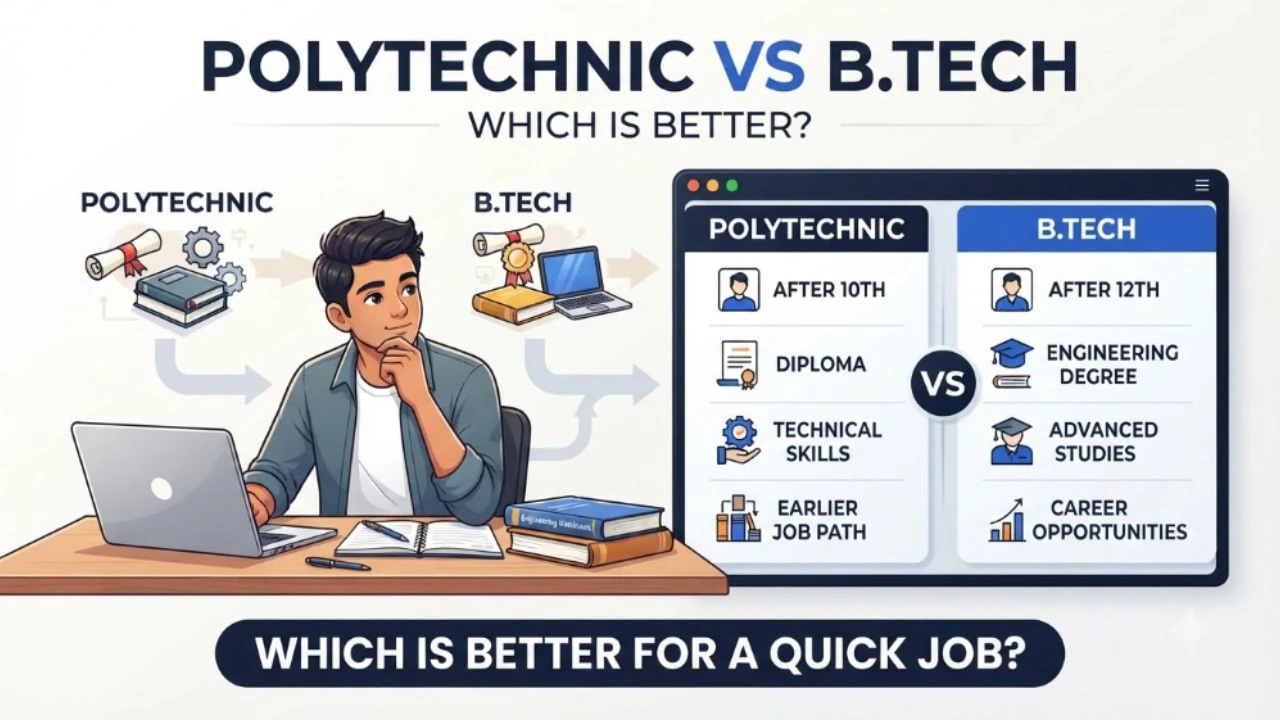
Polytechnic vs B.Tech: Quick Comparison
| Factor | Polytechnic | B.Tech |
| Course type | Diploma | Undergraduate degree |
| Entry point | Usually after Class 10 | Usually after Class 12 |
| Duration | Generally 3 years | Generally 4 years |
| Learning focus | Practical and technical | Theory, design and practical learning |
| Cost | Usually lower | Usually higher |
| Early employment | Strong advantage | Takes longer |
| Higher studies | B.Tech through lateral entry | M.Tech, MBA, MS and other options |
| Typical entry-level roles | Technician, junior technical roles | Engineer, developer, analyst and other graduate roles |
What Is a Polytechnic Course?
A Polytechnic course is a diploma-level technical programme that usually starts after Class 10. Most engineering diploma courses take three years to complete.
The curriculum is more focused on practical technical knowledge. Depending on the branch, students spend time in laboratories, workshops and practical sessions alongside classroom study.
Popular diploma branches include:
- Mechanical Engineering
- Civil Engineering
- Electrical Engineering
- Computer Engineering
- Electronics and Communication Engineering
- Automobile Engineering
Admission can be based on Class 10 marks, state-level entrance examinations or other methods, depending on the state and institution. For example, a student who completes Class 10 and wants to start learning mechanical engineering immediately can enter a diploma programme instead of continuing through the conventional Class 11 and 12 route. After completing the diploma, the student can look for technical employment or explore further education.
What Is B.Tech?
B.Tech, or Bachelor of Technology, is a four-year undergraduate engineering degree. Students generally enter B.Tech after completing Class 12 with the required subjects. Depending on the state and college, admission may involve national or state-level entrance examinations, counselling or other approved routes.
Popular B.Tech specialisations include:
- Computer Science Engineering
- Artificial Intelligence and Data Science
- Mechanical Engineering
- Civil Engineering
- Electrical Engineering
- Electronics and Communication Engineering
The degree covers engineering concepts in greater depth. Students usually study mathematics, core engineering subjects, programming or design concepts, laboratory work, projects and internships depending on their branch. B.Tech also provides a direct route towards graduate-level engineering positions after completion.
Polytechnic vs B.Tech: Which Is Better After Class 10?
For a student who has just completed Class 10, Polytechnic is the more direct technical route. A three-year diploma lets the student start specialised technical education earlier. It can also cost less than completing a four-year engineering degree later.
There is another option worth considering. After completing a diploma, eligible students can apply for lateral entry into the second year of B.Tech in institutions that offer this route. This means a student does not necessarily have to choose between a diploma and an engineering degree forever. Polytechnic can be the first stage, followed by a degree.
However, this route takes longer overall than entering B.Tech directly after Class 12. It should be chosen with that extra time in mind.
Polytechnic vs B.Tech: Which Is Better After Class 12?
If you have already completed Class 12 with the required subjects, B.Tech is generally the more direct route to an engineering degree. You do not need to complete a separate diploma first. Instead, you can apply for B.Tech through the admission route applicable to your state or chosen college.
For students aiming at software development, engineering design, research or other graduate-level positions, the degree can provide a broader academic foundation. Polytechnic after Class 12 can still be considered in some cases, but it may not make much sense to take a diploma first if your clear goal is a B.Tech degree.
Polytechnic vs B.Tech: Fees
Polytechnic diploma programmes at government institutions generally have lower fees compared to private diploma colleges. Whereas B.Tech generally requires a larger financial investment, especially at private colleges. The fee structure also varies widely across states and colleges, so check the current fee details before applying.
Polytechnic vs B.Tech: Job Opportunities
A diploma can help students enter technical employment earlier. Depending on the branch and employer, diploma holders can apply for roles such as technician, junior technical assistant, site supervisor, maintenance technician, CAD operator or other technical positions.
B.Tech graduates have access to a wider range of graduate-level positions. These can include software engineer, design engineer, project engineer, developer, analyst and other roles depending on their branch and skills.
This does not mean every B.Tech graduate automatically gets a higher-paying job. College quality, technical skills, internships, projects, communication and the job market all influence recruitment. The same applies to diploma holders. A student with strong practical skills and relevant experience can build a good career without immediately pursuing a degree.
Polytechnic vs B.Tech: Salary Difference
Salary comparisons should be treated as broad market estimates rather than fixed figures. Diploma holders often start in technical and support-oriented positions, while B.Tech graduates may qualify for graduate engineering and software roles with higher starting salary potential.
The difference can become more noticeable as experience increases, particularly when a degree is required for certain positions or promotion paths. But qualification is only one part of the equation.
A Computer Science graduate with strong programming skills, projects and internships can have very different opportunities from another graduate with little practical experience. Similarly, a diploma holder with strong knowledge of CAD, industrial automation, electrical systems or machine operations can become valuable in the right workplace.
Which Course Gets You a Job Faster?
If the only question is speed, Polytechnic has the advantage. A student can enter a three-year diploma after Class 10 and start looking for employment after completing the course. B.Tech normally requires four years after Class 12.
The comparison becomes more interesting when you look at the complete timeline.
Suppose one student chooses Polytechnic after Class 10. They complete the diploma in three years and can start working. Another student continues with Class 11 and 12 before entering a four-year B.Tech programme. The diploma student reaches the job market earlier.
The B.Tech student spends more time studying but finishes with a degree that can open more graduate-level opportunities. So, faster employment and broader long-term opportunities are not always the same thing.
Polytechnic vs B.Tech: Advantages of Polytechnic
Polytechnic can make sense for students who want to start technical education early.
The main advantages include:
- Admission is generally possible after Class 10
- Diploma courses usually take three years
- Government institutes can be affordable
- Practical training receives considerable attention
- Students can enter technical jobs earlier
- Lateral entry to B.Tech may be available
- Technical skills can be developed at an early stage
Advantages of B.Tech
B.Tech takes longer, but it offers a broader engineering education.
Some major advantages include:
- Four-year engineering degree
- Wider access to graduate-level positions
- More options for postgraduate study
- Stronger eligibility for many engineering roles
- Opportunities across software and core engineering sectors
- Internships and larger academic projects
- Scope for specialisation in newer technology areas
Polytechnic vs B.Tech for Government Jobs
Both qualifications can lead to government employment, but eligibility depends entirely on the recruitment notification. Some technical government positions accept diploma holders, while others require a bachelor’s degree.
For example, diploma qualifications can be relevant to certain Junior Engineer and technician-level recruitment. Graduate-level engineering positions may require a B.Tech or equivalent degree.
Government recruitment is highly specific about educational qualifications. Never assume that a diploma will be accepted simply because the job involves technical work. Read the eligibility section of the latest recruitment notification before preparing for an examination.
Polytechnic vs B.Tech for Private Jobs
Private companies usually look at a combination of qualification, technical ability and experience. Diploma holders commonly enter technician, maintenance, production, site and other hands-on technical roles.
B.Tech graduates can apply for a wider set of engineering and technology positions, particularly where a degree is listed as an essential qualification. In both cases, practical skills matter.
A student who spends three or four years only preparing for examinations may have a weaker job profile than someone who has completed internships, built projects and learned tools used in their industry.
Can Polytechnic Students Do B.Tech Later?
Yes, lateral entry is an important option for diploma holders. Eligible diploma graduates can apply for admission directly into the second year of B.Tech through the applicable lateral-entry process.
The exact eligibility rules, entrance examination requirements and seat availability differ between states and universities. This route can be useful for someone who wants to work after a diploma and pursue a degree later. It also gives students a way to continue their education without starting B.Tech from the first year.
Which Is Better for You?
The answer depends on where you are right now and what you want next.
Choose Polytechnic if:
- You have completed Class 10
- You prefer practical learning
- You want technical education early
- Your budget is limited
- You want to start working sooner
- You may consider B.Tech through lateral entry later
Choose B.Tech if:
- You have completed Class 12 with the required subjects
- You want an engineering degree directly
- You are targeting graduate-level engineering roles
- You want broader opportunities in engineering or technology
- You plan to pursue higher education later
- You are comfortable spending additional time and money on education
Polytechnic vs B.Tech: Final Verdict
If your priority is getting into technical employment as early as possible, Polytechnic can be the better choice, especially after Class 10.
If your priority is earning an engineering degree and keeping broader career options open, B.Tech is usually the more direct route after Class 12.
Before making the decision, compare the actual colleges available to you rather than comparing the course names alone. Fees, placement records, branch quality, internships, location and admission rules can make a major difference. For a student who wants a quick start, Polytechnic has a clear advantage. For someone prepared to invest more time for wider opportunities, B.Tech may offer the stronger long-term route.