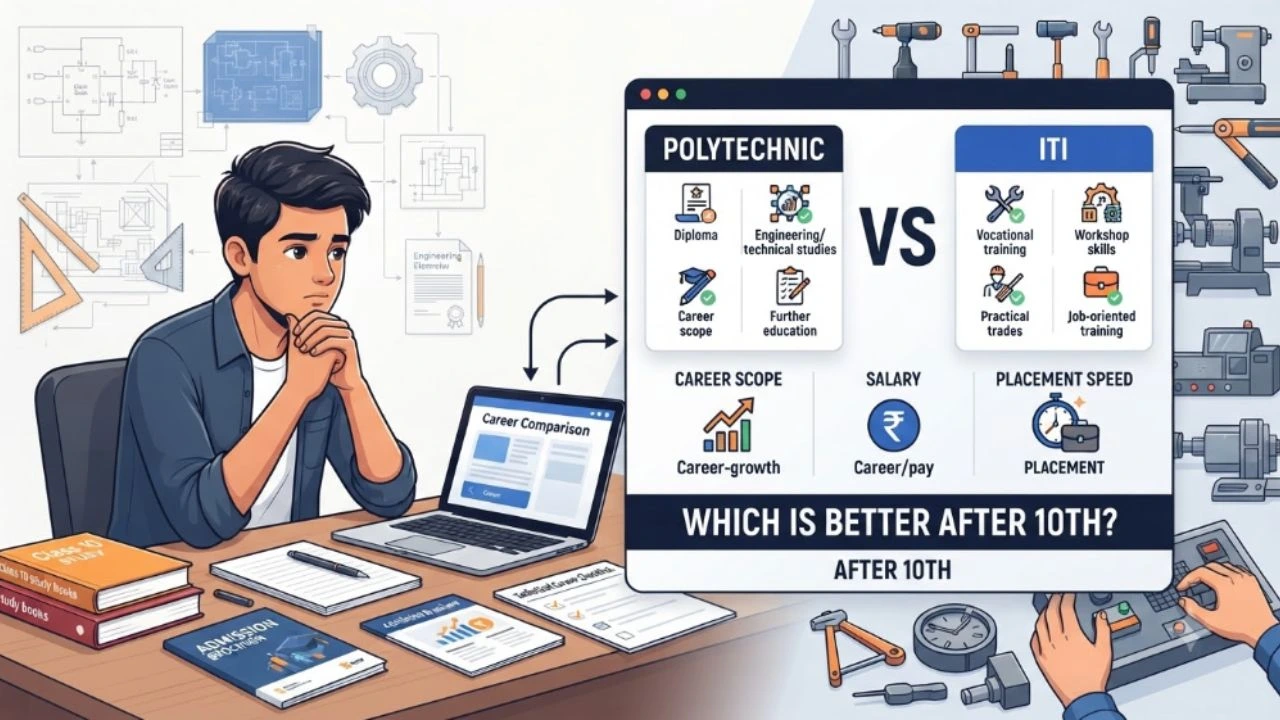
After Class 10, students who want a technical career often compare two practical options: Polytechnic and ITI. Both can lead to technical jobs without following the traditional Class 11 and 12 route, but the training, duration, career opportunities and further education options are different.
ITI courses focus heavily on trade-based skills such as electrician work, fitting, welding, refrigeration, mechanics and computer-related trades. Polytechnic programmes provide broader technical education through diploma-level engineering courses such as Civil, Mechanical, Electrical and Computer Engineering.
The better choice depends on what a student wants after Class 10. Someone looking for hands-on trade training and an early entry into the workforce may prefer ITI. A student aiming for diploma-level engineering education, Junior Engineer recruitment or B.Tech through lateral entry may find Polytechnic more suitable.
Table of Contents
Polytechnic vs ITI: Basic Difference
The biggest difference is the level and type of technical education. A Polytechnic diploma generally provides engineering-oriented education with a combination of theory, laboratory work, workshops and practical assignments. Most engineering diploma programmes after Class 10 take three years.
An ITI course is built around a specific trade. Training is more focused on practical work and job-related skills. Depending on the trade, ITI programmes can last from around six months to two years.
| Factor | Polytechnic | ITI |
| Course type | Engineering diploma | Trade-based vocational training |
| Entry | Usually after Class 10 | Usually after Class 10 |
| Duration | Commonly 3 years | About 6 months to 2 years |
| Main focus | Engineering and technical concepts | Practical trade skills |
| Examples | Civil, Mechanical, Electrical, CSE | Electrician, Fitter, Welder, COPA |
| Higher education | B.Tech lateral entry, where eligible | Further technical education and relevant diploma routes |
| Job entry | Technical and junior engineering roles | Technician, trade and skilled worker roles |
The exact eligibility, duration and admission rules vary by state, institute and trade.
What Is a Polytechnic Course?
A Polytechnic course is a diploma-level technical programme that usually begins after Class 10.
Popular diploma branches include:
- Civil Engineering
- Mechanical Engineering
- Electrical Engineering
- Computer Engineering
- Electronics Engineering
- Automobile Engineering
The curriculum normally includes classroom learning along with laboratory work, workshops and technical projects. For example, a Mechanical Engineering diploma may cover manufacturing, engineering drawing, machine tools, thermodynamics and maintenance. A Civil Engineering student may study surveying, construction materials, structural concepts and project estimation. This combination makes Polytechnic suitable for students who want engineering-related technical education before entering employment or continuing to a degree programme.
What Is an ITI Course?
Industrial Training Institutes provide vocational training in specific trades.
Some popular ITI trades include:
- Electrician
- Fitter
- Welder
- Plumber
- Turner
- Mechanic Motor Vehicle
- Refrigeration and Air Conditioning
- Electronics Mechanic
- Computer Operator and Programming Assistant
- Draughtsman
The training is generally more focused on practical skills required for a particular occupation. An ITI Electrician trainee, for instance, spends considerable time learning electrical wiring, equipment handling, safety procedures and maintenance. A Fitter trainee works with tools, machines, measurements and fitting techniques.
This trade-specific approach can make ITI a practical choice for someone who wants to develop a particular skill and start working sooner.
Polytechnic vs ITI: Course Duration
Course duration is an important difference. Most engineering diploma programmes after Class 10 take three years. Students spend this period studying several technical subjects related to their selected engineering branch.
ITI courses are shorter. Depending on the trade, a programme may last six months, one year or two years. This gives ITI an advantage for students who want to complete formal technical training quickly.
However, shorter duration does not automatically mean better career growth. Polytechnic provides a higher-level engineering foundation, which can be useful for jobs and further education requiring a diploma qualification.
Polytechnic vs ITI: Fees
Both options are generally more affordable than many private engineering degree programmes, but actual fees vary widely. Government Polytechnic institutes usually charge less than private diploma colleges. ITI fees also depend on whether the institute is government-run or private and which trade has been selected. The total cost can include more than tuition.
Students should consider:
- Admission fees
- Examination charges
- Laboratory or workshop fees
- Tools and equipment
- Books
- Uniform
- Hostel
- Transportation
- Other institutional charges
Government institutes in particular can make both routes accessible to students working with a limited education budget.
Which Has Better Scope: Polytechnic or ITI?
Scope depends largely on the kind of work a student wants to enter. Polytechnic has a broader engineering orientation. Diploma holders can explore technical positions in manufacturing, construction, electrical services, automobiles, software support, infrastructure and other sectors.
ITI is more occupation-specific. A trained electrician, fitter, welder or mechanic can apply for jobs that require those particular skills. For a student who already knows the type of technical work they enjoy, ITI can provide a direct route.
Polytechnic may suit someone who wants more flexibility between technical employment, government recruitment and higher education.
Polytechnic vs ITI: Which Has Faster Placement?
Its shorter courses and trade-focused curriculum can prepare candidates for technician and skilled-worker positions in less time. Polytechnic takes longer, but diploma holders may qualify for a wider range of technical roles after completing the programme.
Placement also depends on the institute, location, trade or branch, employer demand, practical skills and the candidate’s performance. Neither qualification guarantees a job immediately after completion.
Apprenticeships can be particularly useful for ITI candidates because they provide workplace exposure. Diploma holders can also find apprenticeship opportunities in suitable technical fields.
Which Offers Higher Salary?
There is no fixed salary advantage for either qualification. An ITI graduate may start with a modest salary in a private workshop, manufacturing unit, service company or contractor-based role. With experience and specialised skills, earnings can increase.
Polytechnic diploma holders may qualify for technical positions with higher starting pay in some companies, particularly when the role requires a diploma qualification. Government recruitment can also change the comparison because eligible diploma holders can apply for selected Junior Engineer and other technical positions.
Salary depends on several factors:
- Job role
- Industry
- Location
- Qualification
- Technical skills
- Experience
- Employer
- Shift and field responsibilities
A skilled ITI electrician with several years of experience can earn more than a fresh diploma holder in some situations. The qualification alone does not determine income.
Government Jobs After Polytechnic
Polytechnic can be useful for candidates interested in technical government recruitment.
Depending on the diploma branch and recruitment rules, opportunities can include:
- Junior Engineer
- Technician
- Technical Assistant
- Apprentice
- Department-level technical positions
Recruitment may come from railways, public works departments, electricity organisations, infrastructure departments, PSUs and other government bodies. Examinations such as SSC JE and RRB JE can be relevant for eligible diploma holders, although candidates must check the qualification requirements for each vacancy. A diploma can also provide a route towards B.Tech through lateral entry where state and university rules allow it.
Government Jobs After ITI
ITI candidates can also pursue government and public-sector employment.
Common areas include:
- Indian Railways
- Defence production organisations
- Electricity departments
- Public sector companies
- State government departments
- Municipal services
- Government workshops
ITI trade apprenticeships are another common route into industrial experience. Recruitment for positions such as technician, trade apprentice and skilled worker often depends on the specific ITI trade and vacancy requirements. Candidates should match their trade with the notification rather than assuming that every ITI qualification is accepted for every technical post.
Higher Studies After Polytechnic
One of Polytechnic’s biggest advantages is the possibility of continuing into engineering education. Eligible diploma holders can often apply for B.Tech lateral entry, which can allow admission directly into the second year of an engineering degree programme.
The admission process differs across states and universities. This route can be useful for a student who wants to start with practical diploma education but later obtain an engineering degree. For example, a student who completes a Diploma in Electrical Engineering may later pursue B.Tech in an eligible related discipline, subject to the applicable admission rules.
Higher Studies After ITI
ITI also does not have to be the end of education. Depending on the trade and eligibility, candidates can pursue further vocational training, apprenticeships and other technical qualifications.
Some students also explore diploma-level technical education after ITI through routes available in their state or institution. The exact progression depends on the trade and admission rules. Anyone planning to move from ITI to a diploma should check the current requirements rather than relying on a general assumption.
Which Is Better for Quick Placement?
If the main objective is finishing technical training quickly and applying for trade-based jobs, ITI has an advantage. A student can complete a suitable ITI trade in a shorter period and start looking for apprenticeships, technician jobs or skilled-worker positions.
Polytechnic takes longer but provides broader engineering education. Therefore, the choice can be viewed like this:
ITI: shorter training + specialised trade + faster entry into skilled work.
Polytechnic: longer diploma + broader engineering knowledge + wider technical and higher-study options.
Which Is Better for Higher Salary?
For long-term salary potential, Polytechnic can have an advantage in many technical career paths because a diploma can provide access to positions requiring higher technical qualifications and can lead to B.Tech through lateral entry.An ITI graduate who develops expertise in areas such as industrial electrical systems, CNC operations, welding, refrigeration or specialised maintenance can build a strong career.
The industry also values experience. A candidate with practical skills and several years of relevant work experience can progress faster than someone with a qualification but limited technical ability.
Polytechnic vs ITI: Which Should You Choose?
Choose ITI if:
- You want practical trade training.
- You want to complete your course quickly.
- You already know which trade interests you.
- You prefer workshop-based learning.
- You want to enter skilled employment or apprenticeship sooner.
Choose Polytechnic if:
- You are interested in engineering subjects.
- You want broader technical education.
- You are considering Junior Engineer recruitment.
- You may pursue B.Tech later.
- You want more flexibility across technical sectors.
For example, someone interested in electrical wiring, maintenance and field work may find an Electrician ITI trade suitable. A student interested in power systems, electrical machines and engineering-level technical work may prefer a Diploma in Electrical Engineering.
Final Verdict: Polytechnic or ITI After 10th?
ITI is generally better for faster, trade-specific training and early entry into skilled employment. Polytechnic takes longer but provides broader engineering education, greater scope for technical roles and a clearer route towards B.Tech through lateral entry for eligible candidates.
Before applying, compare the institute, course curriculum, workshop facilities, fees, apprenticeship opportunities, placement record and further education options. A well-chosen course can matter more than simply choosing Polytechnic or ITI by name.