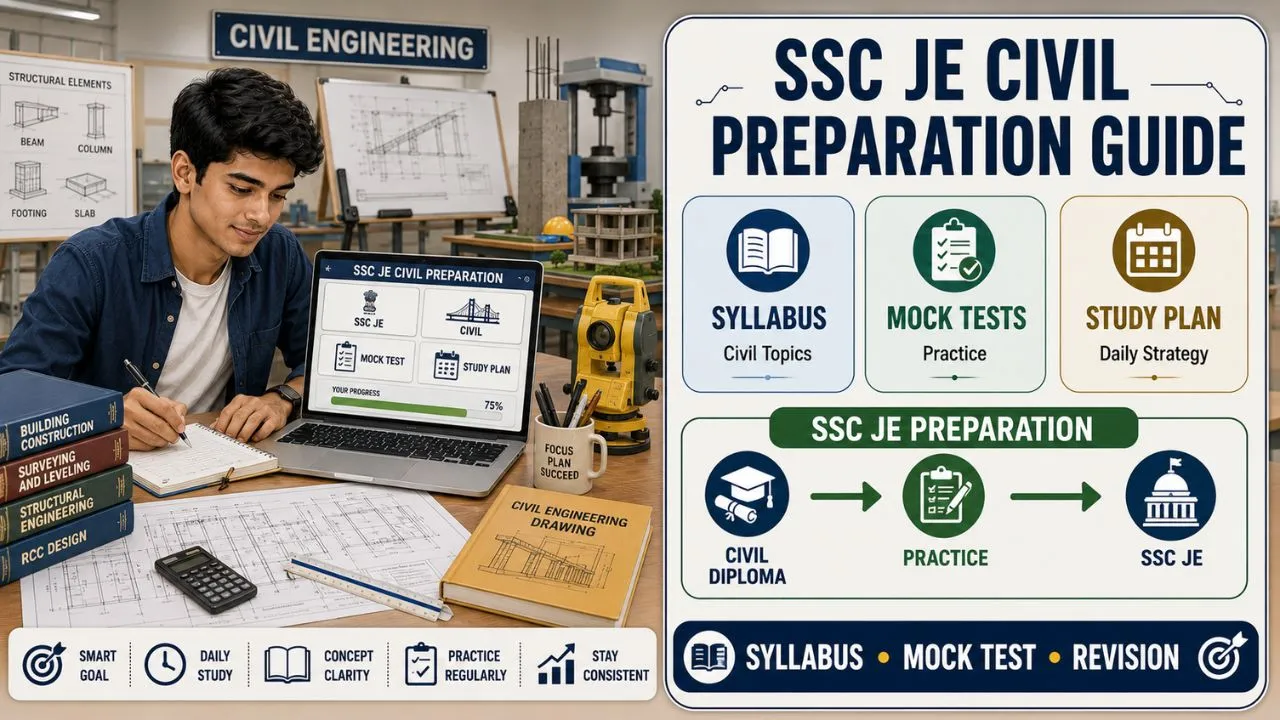
For Civil Engineering diploma students at Government Polytechnic Ambikapur, the SSC Junior Engineer (JE) examination is one of the government job options worth considering after completing the diploma. The exam offers a route toward technical positions in central government departments, but preparation requires more than simply completing the diploma syllabus.
SSC JE covers Civil and Structural Engineering along with General Intelligence and Reasoning and General Awareness. The technical section carries significant weight, so a strong understanding of core Civil Engineering subjects is essential. For a student preparing alongside college studies, the most practical approach is to build concepts gradually, solve questions regularly and use the final months mainly for revision and mock tests.
Table of Contents
What Is SSC JE?
The Staff Selection Commission conducts the Junior Engineer examination for recruitment to technical posts in various central government organisations. Civil Engineering candidates can compete for vacancies in departments and organisations notified through the examination.
The exact posts, departments, vacancies, eligibility conditions and pay details can change from one recruitment cycle to another. That is why candidates should always check the latest SSC notification before applying.
For diploma holders, the eligibility requirement also depends on the post. Some positions accept a three-year diploma in Civil Engineering, while certain posts may specify a degree, diploma or relevant experience. A Civil diploma from a recognised institution can therefore provide an important qualification for eligible SSC JE posts.
Why GP Ambikapur Civil Students Can Start Early
Civil Engineering students spend several semesters studying subjects that overlap with the SSC JE technical syllabus. Subjects such as Engineering Mechanics, Strength of Materials, Surveying, Building Materials, Concrete Technology, Soil Mechanics, Hydraulics, Transportation Engineering and Environmental Engineering form the foundation of Civil Engineering preparation. This creates an advantage for students who start preparation during their diploma.
Instead of treating SSC JE preparation as something to begin after graduation, students can gradually strengthen their concepts while studying each subject at college. For example, when Surveying is taught in class, a student preparing for SSC JE can simultaneously solve objective questions from the same topic. The same method can be followed for Strength of Materials, Fluid Mechanics and other major subjects.
This reduces the pressure of learning the entire technical syllabus from the beginning after completing the diploma.
Understand the SSC JE Exam Pattern First
Before selecting books or starting mock tests, understand the structure of the examination. SSC JE is conducted in two computer-based examination papers.
Paper-I includes General Intelligence and Reasoning, General Awareness and the relevant Engineering subject.
Paper-II focuses on the selected Engineering discipline.
The exact marking scheme, duration, negative marking and syllabus should be checked against the notification for the year in which you apply. This is particularly important because examination patterns and recruitment details can be revised.
Do not prepare based on an old video or previous-year coaching material alone. Keep the latest official notification as your primary reference.
Build Your Civil Engineering Foundation
Technical preparation should receive the largest share of your study time. Start with subjects you are currently studying at Government Polytechnic Ambikapur.
Once a subject is completed in college, revise it again from an SSC JE perspective. The objective is not just to remember formulas. You should understand where and why a formula is used.
For instance, while studying Strength of Materials, learn the relationship between stress, strain, bending moment, shear force and deformation. When preparing Soil Mechanics, understand concepts such as permeability, consolidation, bearing capacity and shear strength instead of memorising definitions alone. The same principle applies to concrete, surveying and fluid mechanics. A strong conceptual base makes objective questions much easier to handle.
Prioritise High-Value Civil Engineering Subjects
Not every topic requires exactly the same amount of preparation time. Major subjects should receive repeated revision because they contain a large number of concepts, formulas and numerical problems.
A useful sequence can begin with:
- Engineering Mechanics
- Strength of Materials
- Structural Analysis
- RCC and Steel Design
- Building Materials and Construction
- Soil Mechanics
- Foundation Engineering
- Fluid Mechanics
- Hydraulics
- Irrigation Engineering
- Surveying
- Transportation Engineering
- Environmental Engineering
The order can be adjusted according to your college syllabus and individual strengths. Do not completely ignore smaller topics simply because they appear difficult. SSC JE questions can come from different parts of the prescribed syllabus, so your preparation should eventually cover the complete subject list.
Make Short Notes While Studying
Civil Engineering contains a large number of formulas, definitions, units and technical relationships. Trying to remember everything directly from textbooks can make revision difficult.
Create concise notes while completing each topic. For Strength of Materials, maintain a separate formula section for commonly used relationships. For Surveying, note important terms, instruments, corrections and formulas.
For Soil Mechanics, keep important definitions and numerical relationships together. The purpose of these notes is quick revision. Do not copy entire chapters into a notebook.
A useful revision sheet should allow you to revise a topic in minutes rather than hours.
Do Not Ignore General Intelligence and Reasoning
Technical subjects may be the core of your preparation, but General Intelligence and Reasoning also need regular practice. The good news is that reasoning can improve significantly through repeated question solving.
Focus on topics such as:
- Analogy
- Classification
- Series
- Coding and decoding
- Direction sense
- Blood relations
- Venn diagrams
- Statement-based questions
- Syllogism
- Non-verbal reasoning
- Basic logical problems
Instead of studying reasoning for several hours once a week, spend a short period on it regularly.
Twenty to thirty minutes of consistent practice can be more useful than an occasional long session.
Keep General Awareness Under Control
General Awareness can become time-consuming if preparation is not organised properly. Avoid trying to memorise every piece of current news. Focus on areas relevant to the SSC examination, including basic science, history, geography, polity, economics and important current events.
For current affairs, maintain concise notes rather than collecting multiple sources. Revision matters more than continuously adding new information.
A student preparing for a technical examination should also avoid allowing General Awareness preparation to consume the time needed for Civil Engineering.
Use Previous-Year Questions as a Study Tool
Previous-year questions are among the most useful resources for SSC JE preparation. They help you understand the level of questions and identify topics that repeatedly require attention.
Do not wait until the final month to solve them. After completing a chapter, solve relevant previous-year questions from that topic.
Suppose you finish a chapter on Surveying. Attempt questions related to that chapter before moving to the next subject.
This approach shows whether you actually understood the concepts. Keep a separate record of questions you answered incorrectly. Review those mistakes after a few days. Over time, this error notebook can become one of your most useful revision resources.
Create a Practical Study Schedule
A diploma student does not need to study for ten or twelve hours every day to begin SSC JE preparation.
Consistency is more important during the early stages. A college student can divide daily preparation into manageable sessions. For example, one session can be dedicated to a Civil Engineering concept, another to numerical questions and a shorter session to reasoning or General Awareness.
During examination breaks, study time can be increased. A practical weekly plan could include five days of regular subject preparation, one day for mixed practice and one day for revision and testing. The schedule should remain realistic. A timetable that looks impressive but cannot be followed for more than a week will not help much.
Balance College Exams and SSC JE Preparation
GP Ambikapur students should not treat college studies and SSC JE preparation as two completely separate tasks. Many diploma subjects overlap with the technical syllabus.
When internal examinations or semester exams approach, give priority to college academics while continuing shorter SSC JE practice sessions. The technical knowledge developed for semester examinations can later support competitive exam preparation.
The main difference is that SSC JE requires faster recall and objective problem-solving. After completing a college topic, practise applying the same knowledge to multiple-choice questions. That transition should happen gradually.
Mock Tests Should Come After Concept Building
Mock tests are valuable, but taking full-length tests without adequate preparation can become discouraging. Start with chapter-wise tests.
Move to subject-wise tests once several topics have been completed. Full-length mock examinations should become more frequent closer to the actual examination.
After every test, spend time analysing the result. Do not focus only on the score.
Check whether the mistake happened because of:
- Lack of knowledge
- Formula confusion
- Calculation error
- Misreading the question
- Poor time management
- Guessing
Different mistakes require different solutions. If a question was wrong because you did not know the concept, revise it. If the concept was known but the calculation went wrong, increase numerical practice.
Improve Numerical Problem-Solving Speed
Civil Engineering examinations can contain numerical questions where knowing the formula is only the first step. You must identify the relevant data, select the correct relationship, calculate efficiently and reach the answer within the available time.
Avoid relying entirely on lengthy calculations. With practice, you will begin recognising common patterns. Keep track of units carefully.
Many avoidable mistakes occur because candidates overlook conversions or use an incorrect unit. Practice calculations regularly, particularly in Strength of Materials, Fluid Mechanics, Soil Mechanics, Surveying and other numerical-heavy subjects.
Common Mistakes to Avoid
Many candidates make preparation unnecessarily difficult by constantly changing their study resources. Choose reliable books and study material, then stay with them.
Collecting ten different books for the same subject does not guarantee better preparation. Another common mistake is postponing revision.
A topic studied once will not remain equally fresh several months later. Revision should be built into the timetable from the beginning. Some students also spend too much time watching preparation videos instead of solving questions.
Videos can help explain difficult concepts, but question practice should remain a major part of preparation. Finally, do not ignore weak subjects.
Avoiding a difficult topic gives temporary comfort but creates a bigger problem before the examination.
A Six-Month Preparation Approach
If you have approximately six months available, divide the preparation into clear phases. During the first two months, focus primarily on completing and understanding the Civil Engineering syllabus. The next two months can combine revision with previous-year questions and chapter tests.
The fifth month should involve more mixed practice, timed tests and systematic revision of weak areas. Use the final month mainly for mock examinations, formula revision, error analysis and repeated practice.
This is only a framework. Students who already have a strong technical foundation can move faster, while those starting from scratch may need more time for concept building.
Career Preparation Should Not Stop With SSC JE
Preparing for SSC JE can also strengthen your foundation for other technical examinations. Depending on eligibility, Civil diploma holders can explore opportunities through state government departments, public-sector organisations, Railways and other technical recruitment processes.
The syllabus is not identical across all examinations, but core Civil Engineering knowledge often remains useful. That means the effort invested in subjects such as Surveying, Soil Mechanics, Strength of Materials and Construction can continue to benefit you beyond one examination.
You should still prepare separately for the pattern and syllabus of every examination you apply for.
Final Strategy for GP Ambikapur Civil Diploma Aspirants
SSC JE preparation becomes manageable when it is approached as a long-term process rather than a last-minute project. For GP Ambikapur Civil Engineering students, the best time to begin is while building the fundamentals of the diploma itself.
Study each subject properly, make concise notes, solve previous-year questions and revise difficult topics regularly. Give technical subjects the attention they deserve, while maintaining consistent practice in reasoning and General Awareness.
A Civil Engineering diploma provides the academic foundation. Your preparation, problem-solving ability and practical understanding will determine how effectively you use it in a competitive examination. For a GP Ambikapur student targeting SSC JE, steady preparation during the diploma can be far more effective than trying to cover the entire syllabus after graduation.