Railway Junior Engineer is one of the most attractive technical government job options for diploma holders who want a stable career in the public sector. The recruitment is conducted by the Railway Recruitment Boards for technical positions across different railway zones. For diploma students, RRB JE offers a direct opportunity to compete for technical roles without completing a B.Tech degree first. However, the competition is considerable, and preparation needs to cover both general subjects and the technical syllabus related to the candidate’s diploma branch.
Candidates from Civil, Mechanical, Electrical, Electronics and allied engineering disciplines can apply when their qualification matches the requirements mentioned in the recruitment notification. For students currently pursuing or completing a diploma, the right preparation strategy can make the difference between simply appearing for the examination and achieving a competitive score.
Table of Contents
RRB JE Eligibility for Diploma Holders
The eligibility requirements depend on the post and discipline advertised in the particular recruitment notification. Diploma holders in relevant engineering disciplines are eligible for several Junior Engineer positions. Candidates generally need a recognised diploma in the engineering discipline specified for the post.
The age requirement is also determined by the recruitment notification. Different categories may receive age relaxation according to applicable government rules. A diploma holder should never rely only on eligibility information from an old RRB JE notification. Recruitment rules, vacancies, accepted qualifications and post-wise requirements can change.
Before submitting an application, check the latest official notification carefully, particularly the educational qualification section.
RRB JE Selection Process
RRB JE recruitment generally involves multiple stages. The first computer-based examination tests general subjects along with basic technical knowledge. Candidates who qualify move to the next stage, where technical knowledge carries greater importance.
The recruitment process can include document verification and a medical examination after the computer-based tests. The exact structure, marks and qualifying requirements should always be checked against the notification for the recruitment cycle in which you are applying.
This is important because candidates often prepare using old exam patterns without checking whether the current recruitment has changed the weightage or structure.
Understand the RRB JE Syllabus Before Preparing
Preparation becomes easier when the syllabus is divided into separate areas instead of treating the examination as one large subject. The non-technical section generally covers Mathematics, General Intelligence and Reasoning, General Awareness, and subjects related to general science.
The technical section is based on the engineering discipline mentioned in the application. For diploma holders, technical preparation deserves particular attention because the syllabus is closely connected with subjects studied during the diploma programme. A good strategy is to revise diploma-level concepts first and then move toward objective questions and previous examination papers.
Mathematics Preparation Strategy
Mathematics is part of the general section and requires regular practice. Important areas can include number systems, algebra, ratios, percentages, averages, profit and loss, time and work, time and distance, geometry, trigonometry and statistics.
Do not spend weeks studying mathematics only through theory. Solve questions regularly and maintain a small notebook for formulas and mistakes. If a particular topic repeatedly produces incorrect answers, revise the underlying concept before attempting another large question set.
Speed also matters because competitive examinations involve limited time. Once the basic concepts become comfortable, practice mixed question sets with a timer.
General Intelligence and Reasoning
Reasoning can become a scoring area when practiced consistently. Questions may cover analogy, classification, coding-decoding, series, syllogism, mathematical operations, relationships, directions and other logical patterns.
The most effective approach is regular practice rather than occasional long study sessions. Start with simpler questions and gradually increase difficulty. During mock tests, note which reasoning topics consume too much time. Learning when to skip a difficult question can be as useful as knowing how to solve it.
General Science and Awareness
General Science is particularly manageable for diploma holders because much of the basic science foundation comes from school-level education. Revise fundamental concepts from Physics, Chemistry and Life Science.
Focus on understanding rather than memorising large amounts of disconnected information. General Awareness requires a different approach. Keep track of major national developments, government programmes, important organisations, sports, science and technology developments, and other areas relevant to competitive examinations.
Do not spend most of your preparation time reading current affairs at the expense of technical subjects.
Branch-Wise Technical Preparation
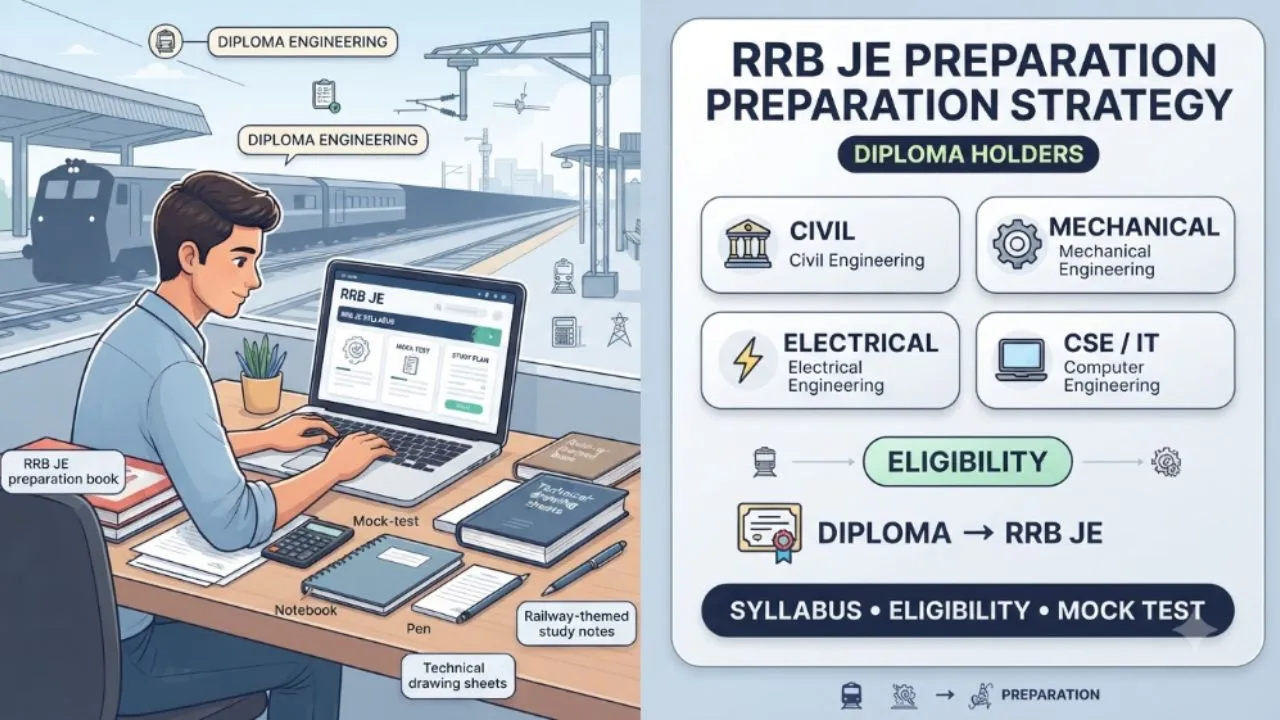
The technical section should be prepared according to the diploma branch mentioned in the RRB JE application. This is where diploma holders can use their academic background to their advantage.
Civil Engineering
Civil Engineering candidates should revise subjects connected with construction and infrastructure.
Important areas include Building Materials, Construction Technology, Surveying, Engineering Mechanics, Strength of Materials, Structural Engineering, Concrete Technology, Soil Mechanics, Transportation Engineering, Hydraulics and Environmental Engineering. Surveying deserves special attention because it contains many formulas and practical concepts.
Candidates should also revise construction materials, concrete properties, foundations, roads and basic structural concepts. Rather than reading complete textbooks repeatedly, make concise notes from diploma-level subjects and use objective questions to test retention.
Mechanical Engineering
Mechanical diploma holders should focus on core subjects such as Engineering Mechanics, Strength of Materials, Thermodynamics, Fluid Mechanics, Manufacturing Processes, Machine Design, Theory of Machines and Industrial Engineering.
Basic concepts of heat engines, materials, machining, production processes and mechanical systems should be clear. If an error occurs, identify whether the problem came from the formula, calculation or conceptual understanding.
Electrical Engineering
Electrical candidates should revise Electrical Machines, Basic Electrical Engineering, Power Systems, Measurements, Control Systems, Electrical Circuits and related technical subjects.
Transformers, motors, generators, circuit laws and electrical measurements are particularly important areas for revision.
Candidates should also understand fundamental power-generation and transmission concepts.
Practice numerical problems regularly because technical questions can become time-consuming when calculations are unfamiliar.
Electronics and Communication Engineering
Electronics diploma holders should focus on Electronic Devices, Digital Electronics, Analog Electronics, Communication Systems, Microprocessors, Microcontrollers, Measurements and basic computer-related concepts. Diodes, transistors, amplifiers, logic gates and digital circuits should be revised carefully.
Candidates should not limit preparation to definitions. Objective examinations often test the practical application of a basic concept through numerical or circuit-based questions.
Computer Science and IT
Candidates from Computer Science and Information Technology backgrounds should revise Programming Fundamentals, Data Structures, Database Management, Operating Systems, Computer Networks and basic Web Technologies.
Database concepts, networking fundamentals, operating systems and programming logic require regular practice.
Do not spend excessive time learning advanced programming frameworks that are outside the examination syllabus. The priority should remain on the topics mentioned in the technical syllabus.
A Practical RRB JE Preparation Strategy
A strong preparation plan should divide the day between technical and non-technical subjects. For diploma holders, technical subjects can receive the largest portion of study time because the syllabus is extensive and closely related to their engineering discipline.
One practical approach is to study one technical subject in depth during the first session. Use the second session for Mathematics or Reasoning.
Reserve another period for General Science and General Awareness. The exact schedule can change according to the candidate’s strengths.
Someone with strong technical knowledge but weak mathematics should devote additional time to mathematics.
Likewise, a candidate who has forgotten diploma subjects after graduation should begin with technical revision before attempting advanced mock tests.
Use Previous-Year Questions Properly
Previous-year questions are among the most useful preparation resources for competitive examinations. They help identify recurring concepts and reveal the level of questions candidates can expect. This analysis tells you what needs improvement.
Repeat difficult topics after a few days and attempt similar questions again.
Mock Tests and Time Management
Mock tests become increasingly important during the final stage of preparation. Begin with topic-based tests and gradually move toward full-length examinations. Try to recreate actual exam conditions during full mocks. Keep your phone away and avoid checking notes during the test.
If a particular section consumes too much time, change the order in which you attempt questions. Avoid getting stuck on one difficult technical problem while easier questions remain unanswered.
How Diploma Students Can Prepare Alongside College
Students still attending Government Polytechnic or another diploma college can start RRB JE preparation without waiting for graduation. The advantage is that technical subjects are already part of the academic curriculum.
Instead of studying the same subject twice, connect college preparation with competitive-exam preparation. After completing a chapter in class, solve objective questions from the same topic.
Keep separate notes for formulas, important definitions and frequently repeated concepts. Students from institutions such as GP Ambikapur can also use their laboratory and workshop exposure to understand technical concepts more clearly.
The same principle applies when comparing colleges or branches. A discussion such as GP Ambikapur vs GP Korba should not be based only on reputation. Branch availability, practical exposure and the student’s intended career path also matter.
For a student specifically interested in mining, choosing a suitable diploma institution and building technical skills can be more useful than chasing a generic label such as the best mining diploma college in Chhattisgarh.
Common Mistakes to Avoid
One common mistake is starting preparation with advanced coaching material without revising diploma-level fundamentals. Another is ignoring Mathematics and Reasoning because the candidate belongs to an engineering background.
Some candidates also spend too much time collecting study material and too little time solving questions. Avoid changing books and preparation strategies every few weeks.
Choose reliable study material, complete the syllabus systematically and use mock tests to identify weak areas. Candidates should also avoid assuming that qualifying the examination guarantees selection.
Final selection depends on the recruitment process, merit, vacancies, eligibility, document verification and other applicable conditions.
Final Words
RRB JE is a strong career option for diploma holders who want to enter the railway sector through a technical position. The preparation requires more than memorising general knowledge or solving a few practice papers.
A better approach combines diploma-level technical revision with regular Mathematics, Reasoning, General Science and General Awareness practice. Branch-specific preparation should remain at the centre of the study plan.
Civil, Mechanical, Electrical, Electronics and Computer-related diploma holders should first identify the technical subjects relevant to their post and then work through them systematically. Previous-year papers, mock tests and mistake analysis can improve both accuracy and speed.
Most importantly, begin preparation early. A diploma holder who consistently revises technical concepts, practices objective questions and monitors performance has a much stronger foundation for competing in RRB JE recruitment.