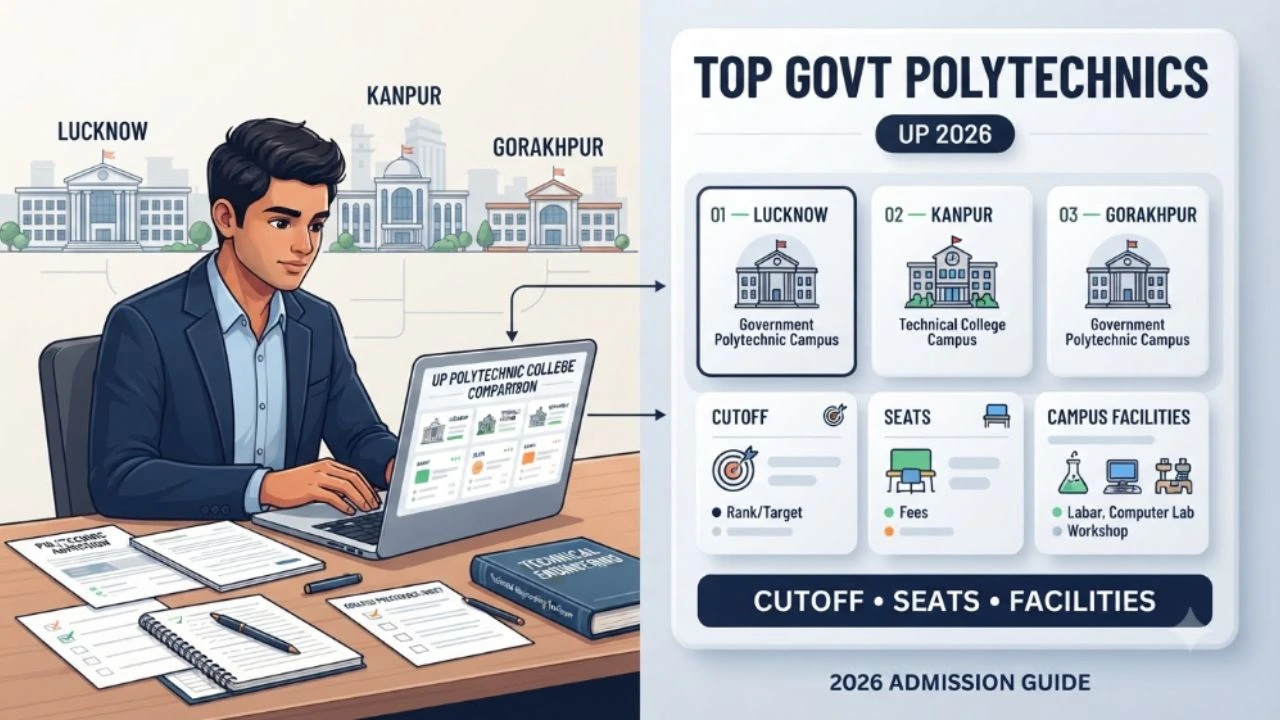
Government polytechnic colleges in Uttar Pradesh remain a popular choice for students looking for affordable technical education after Class 10. Compared with many private institutes, government colleges usually have lower fees and a strong focus on practical training. For 2026 admissions, students are mainly interested in three things: previous cutoff trends, available seats and campus facilities. These factors can help narrow down college choices during counselling.
UP has government polytechnic institutes across major cities, including Lucknow, Kanpur, Gorakhpur, Agra, Prayagraj, Varanasi and other districts. The right college, however, depends on more than its location. Branch availability, previous closing rank, hostel facilities, laboratories and travel distance also matter.
Table of Contents
Government Polytechnic Admission in UP 2026
Admission to many government polytechnic programmes in Uttar Pradesh is conducted through the JEECUP admission process. The exact admission route depends on the course and the applicable rules for the academic session.
For engineering diploma courses, Class 10 is generally the entry point. Students usually need Mathematics and Science as part of their qualifying examination, along with the required minimum marks.
The broad admission process involves:
- Checking eligibility for the selected group and branch.
- Registering for the entrance examination, wherever applicable.
- Appearing for JEECUP.
- Checking the result and rank.
- Registering for counselling.
- Filling college and branch choices.
- Participating in seat allotment.
- Completing document verification.
- Reporting to the allotted institute and paying the required fees.
Admission rules, dates and eligibility requirements can change, so applicants should check the current 2026 admission notification before submitting an application.
Top Government Polytechnic Colleges in UP
Uttar Pradesh has several established government polytechnic institutes. There is no single official ranking that places every government polytechnic in a fixed order, so it is more useful to compare colleges based on their location, branches, facilities, fees, previous admission trends and academic environment.
Government Polytechnic Lucknow
Government Polytechnic Lucknow is one of the better-known government diploma institutes in the state capital.
Its location gives students access to a large urban environment and a wider range of industries and technical organisations. Depending on the admission year and available seats, students may find engineering and technical diploma options across different disciplines.
Common areas of interest include branches related to:
- Civil Engineering
- Mechanical Engineering
- Electrical Engineering
- Computer-related studies
- Electronics and other technical disciplines
The main advantage is its established presence in Lucknow and comparatively affordable government-college fee structure. Students considering this institute should check the branch-wise availability before filling their counselling choices.
Government Polytechnic Kanpur
Kanpur is an important industrial city, making it a practical location for students interested in engineering and technical education. Government polytechnic institutes in and around Kanpur offer students exposure to a city with manufacturing, engineering, leather, chemical and other industrial activities.
For diploma students, practical learning becomes particularly valuable in branches such as Mechanical, Electrical and Civil Engineering. Before choosing a college in Kanpur, applicants should compare the available branch, previous closing rank and facilities rather than selecting the institute only because of its city.
Government Polytechnic Gorakhpur
Gorakhpur is another important education centre in eastern Uttar Pradesh. Government polytechnic education in the region provides an affordable option for students who prefer studying closer to home. The institute and surrounding area can be particularly relevant for applicants from eastern UP districts who do not want the additional expense of relocating to Lucknow or another major city.
Branch availability, hostel arrangements and transport facilities should be checked for the specific academic session.
Government Polytechnic Cutoff 2026
The UP Polytechnic cutoff 2026 cannot be treated as one fixed number for every college.
Cutoff changes according to several factors, including:
- JEECUP rank or score
- College preference
- Diploma branch
- Category
- Number of available seats
- Number of applicants
- Counselling round
- Previous admission trends
A popular branch such as Computer Science or Computer Engineering can attract considerably more applicants than some traditional branches. For this reason, a student with a particular rank should not fill only one or two choices. A broader preference list can provide more options during counselling.
How to Read Previous-Year Cutoffs
Previous-year closing ranks are useful for understanding competition, but they do not guarantee a seat in 2026.
Suppose a particular government polytechnic closed at a certain rank in the previous counselling cycle. That does not mean the same rank will be sufficient this year. A change in applications, seat availability, category-wise distribution or branch preference can move the closing rank.
Seats in Government Polytechnic Colleges
The number of seats differs from one college and branch to another. A government polytechnic may have different intake capacities for Civil, Mechanical, Electrical, Computer Engineering and other diploma programmes. Some branches may have more seats than others.
Seat availability can also vary because of:
- Approved intake
- Branch-specific capacity
- Category reservations
- New courses
- Changes in institutional approval
- Seat upgrades or modifications
The safest approach is to check the seat matrix available during the 2026 counselling process. Students should also remember that the number of total seats in a college is less important than the number available in the branch they actually want.
Campus Facilities to Check
A government college does not automatically mean that every campus will have identical facilities. Before finalising a college, look at the practical resources available for the chosen branch.
Laboratories
Engineering diplomas involve substantial practical work. Electrical, Mechanical, Civil and Computer branches each require different laboratory facilities.
A good laboratory should allow students to work with equipment rather than relying only on classroom explanations.
Workshops
Mechanical and related engineering programmes require workshop exposure. Machines, tools and practical assignments help students understand how technical concepts work outside textbooks.
Computer Facilities
For Computer Engineering and IT-related programmes, students should check computer laboratory facilities, software availability, internet access and opportunities for practical programming work.
Library
A functional library can support both regular coursework and preparation for competitive examinations.
The number of books is not the only factor. Updated technical material and access to useful reference resources also matter.
Hostel
Hostel availability can be important for students travelling from another district.
However, students should check whether accommodation is actually available for their batch, whether separate facilities exist for boys and girls, and what additional charges apply.
Transportation
Students living outside the city should consider daily travel time and transportation costs. A college with slightly higher travel expenses can become considerably more expensive over three years.
Fees at Government Polytechnic Colleges
Government polytechnic colleges are generally much more affordable than private diploma institutes.
However, the total amount payable is not limited to tuition fees. Students may also have to consider:
- Admission charges
- Examination fees
- Laboratory charges
- Library fees
- Hostel charges
- Uniform expenses
- Books and study material
- Transportation
- Other institutional charges
The exact fee depends on the institute, course and applicable government rules. Students eligible for scholarships may also receive financial support under applicable state or central schemes. Eligibility depends on factors such as category, income, domicile and other conditions.
Which Polytechnic Branch Should You Choose?
The branch can have as much impact on your future options as the college itself.
Computer Engineering
Computer-related diploma courses are suitable for students interested in programming, software, networking and information technology.
Students can later explore software-related jobs, technical support, networking or higher education.
Mechanical Engineering
Mechanical Engineering is a practical choice for students interested in machines, manufacturing, production and maintenance. It can lead towards manufacturing plants, automobile companies, workshops and industrial organisations.
Civil Engineering
Civil Engineering focuses on construction, surveying, infrastructure and related technical work. Diploma holders can explore site-based roles, construction companies, infrastructure projects and government technical recruitment where eligible.
Electrical Engineering
Electrical Engineering covers electrical systems, power, machines, wiring, maintenance and industrial applications. It can be relevant to power-related organisations, manufacturing units, electrical contractors and technical service companies.
Government Polytechnic vs Private Polytechnic
The government-versus-private comparison should not be based on fees alone.
| Factor | Government Polytechnic | Private Polytechnic |
| Fees | Usually lower | Usually higher |
| Admission | Often entrance/counselling based | Depends on institute |
| Competition | Can be high | Varies |
| Infrastructure | Varies by college | Varies by college |
| Hostel | Depends on campus | Depends on campus |
| Placement | Depends on branch and institute | Depends on branch and institute |
| Academic environment | Varies | Varies |
A private college can have better facilities in some areas, while a government institute may offer stronger value because of lower fees.
The individual college matters more than the label.
How to Choose a Government Polytechnic College in UP
Do not select a college only because its cutoff is low. Start with the branch you want and then compare colleges offering that branch.
For example, if your main interest is Computer Engineering, a college with excellent Civil Engineering facilities does not automatically become the right choice.
Consider these factors before locking your counselling choices:
- Previous closing rank
- Available branch
- Seat intake
- College location
- Hostel availability
- Laboratory facilities
- Workshop facilities
- Faculty
- Placement record
- Fees
- Travel expenses
- Higher-study opportunities
Location can also make a major difference.
A student from Gorakhpur may find a local college more economical than moving to Lucknow, especially after adding hostel, food and travel costs.
Career Options After Government Polytechnic
A diploma can provide several routes after completion.
Some graduates begin working in technical positions, while others continue their education.
Possible options include:
Private employment: Technician, junior technical roles, site supervisor, maintenance technician and other branch-specific positions.
Government recruitment: Diploma holders can apply for technical posts when the particular recruitment notification accepts their qualification.
Apprenticeships: Apprenticeship programmes can provide practical workplace experience after completing the diploma.
B.Tech lateral entry: Eligible diploma holders can apply for lateral entry into engineering degree programmes, generally entering beyond the first year depending on the applicable rules.
The career outcome depends heavily on branch, technical skills, experience, location and the recruitment requirements of the employer.
Final Words
Government polytechnic colleges in Uttar Pradesh can be a practical option for students who want affordable technical education after Class 10. Lucknow, Kanpur and Gorakhpur are among the important locations to consider, but the right choice depends on the branch, previous cutoff, available seats, campus facilities and total cost.
For 2026 admission, do not rely only on previous-year cutoff lists. Check the current counselling information, seat matrix and admission rules before filling your choices. A sensible preference list should include colleges and branches that match your rank as well as a few realistic alternatives. That approach gives you more flexibility while making the final decision.